How to Construct a 200L Yogurt Making Process: Complete Setup Guide
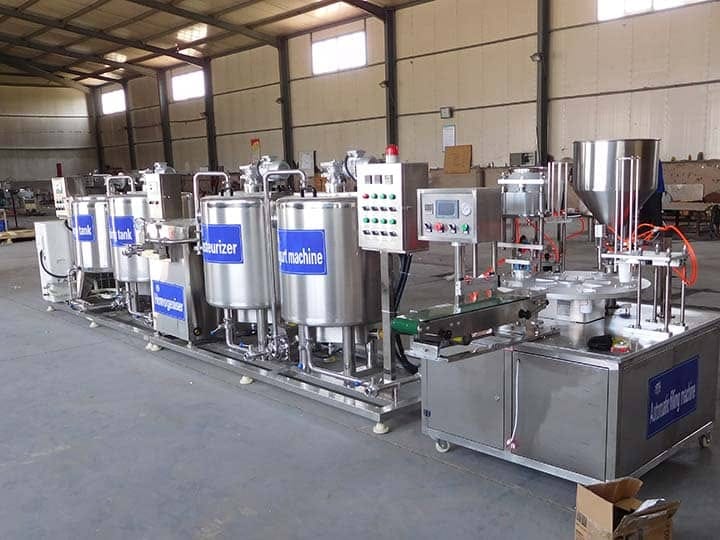
The industrial yogurt making process can better meet the needs of modern companies for dairy manufacturing. A 200L yogurt production line is the ideal entry point for small businesses, dairy farm diversification, and market testing. This comprehensive guide covers equipment configuration, facility requirements, utility specifications, and installation procedures to help you construct an efficient 200L yogurt making process.
Install CIP System: Connect cleaning system to all equipment
Phase 3: Commissioning (1 week)
Electrical Testing: Test all electrical connections and controls
Water Testing: Run water through all pipelines and tanks
Leak Testing: Check all connections for leaks
CIP Testing: Run cleaning cycle to verify system
Trial Production: Run first production batch with water
Phase 4: Validation (1 week)
First Production: Run first yogurt production batch
Quality Testing: Test product for quality parameters
Parameter Adjustment: Fine-tune temperatures and timing
Operator Training: Train production team on operation
Documentation: Complete installation and validation records
Case Study: 200L Yogurt Line in Saudi Arabia
Shuliy successfully installed a 200L yogurt production line in Saudi Arabia, providing a complete turnkey solution based on the customer's investment needs. The project included:
Item
Specification
Capacity
200L/day
Product
Plain and flavored yogurt
Packaging
200g cups
Control System
PLC automatic
Installation Time
3 weeks
Training
5 operators trained
Production Start
4 weeks from order
Conclusion
Constructing a 200L yogurt making process requires careful planning of equipment configuration, facility layout, utility requirements, and installation procedures. With proper planning and professional support, you can establish an efficient production line within 4-6 weeks.
Contact Shuliy Machinery for a customized 200L yogurt production line solution. Our experienced team will provide complete design, installation, and training services based on your specific requirements.
How much space do I need for a 200L yogurt production line?
A 200L yogurt production line requires 20-30 m² of floor space with 3-4 meters ceiling height. The layout should include separate zones for raw milk reception, processing, fermentation, filling, and cleaning.
What utilities are required for a 200L yogurt line?
Required utilities include: 380V/50Hz three-phase power (15-25 kW), drinking quality water (600-1000L/day), compressed air (6-8 bar), and optionally steam (0.3-0.5 MPa) for heating.
How long does it take to install a 200L yogurt production line?
Installation typically takes 4-6 weeks, including 1-2 weeks for site preparation, 1-2 weeks for equipment installation, 1 week for commissioning, and 1 week for validation and training.
What is the daily output of a 200L yogurt line?
A 200L yogurt production line can produce 400-600 cups (200g each) per day, operating 8-10 hours per single shift.
10 thoughts on “How to Construct a 200L Yogurt Making Process: Complete Setup Guide”
Hi
I like your mini yogurt plant but I need some more information on
1. The different parts/equipment of the process flow. A video clip of the production process
2. I would like to make yogurt in different flavours packed in 150ml, 250ml cups sealed with folio. What is the packing machine capacity.?
3.I would like to pack milk in 250ml, 500ml, and 1,000ml. What is the packing machine capacity?
4. Does your CIP system have a boiler?
5. I am interested in a 500L per day processing plant.
Please share a quotation for the above
Hello, received your information, arranged the sales manager to contact you
I am from Uganda.
Yes
W
Arranged the sales manager to contact you, she will contact you so soon.
Hello,
I live in Nigeria. I work in Food Science Department of a university and we are interested in setting up a small-scale Yoghurt Production plant that can handle 150-200 Litre drink yoghurt. This set up is okay except that there should be a filler that will be able to dispense into tetrapack of 100ml, 250ml and 500ml circa.
Can you forward to me the equipment and financial implications of setting it up and other requirements.
Thanks
Hello, thanks for yorur inquiry. I have informed professional maanger to send machine details and price to you, pls attention email from shuliy
Hola buenos días, estoy interesada en saber de una planta de producción de 500 litros de yogur batido que contenga mermelada. Nos encantaría que nos envíe la información de las maquinarias y el costo de cada una de ellas. Muchas gracias
Hola, le he informado a un gerente profesional para que le envíe los detalles de la máquina y el precio. Por favor, envíe un mensaje de atención de Shuliy.

Hi
I like your mini yogurt plant but I need some more information on
1. The different parts/equipment of the process flow. A video clip of the production process
2. I would like to make yogurt in different flavours packed in 150ml, 250ml cups sealed with folio. What is the packing machine capacity.?
3.I would like to pack milk in 250ml, 500ml, and 1,000ml. What is the packing machine capacity?
4. Does your CIP system have a boiler?
5. I am interested in a 500L per day processing plant.
Please share a quotation for the above
Hello, received your information, arranged the sales manager to contact you
I am from Uganda.
Yes
W
Arranged the sales manager to contact you, she will contact you so soon.
Hello,
I live in Nigeria. I work in Food Science Department of a university and we are interested in setting up a small-scale Yoghurt Production plant that can handle 150-200 Litre drink yoghurt. This set up is okay except that there should be a filler that will be able to dispense into tetrapack of 100ml, 250ml and 500ml circa.
Can you forward to me the equipment and financial implications of setting it up and other requirements.
Thanks
Hello, thanks for yorur inquiry. I have informed professional maanger to send machine details and price to you, pls attention email from shuliy
Hola buenos días, estoy interesada en saber de una planta de producción de 500 litros de yogur batido que contenga mermelada. Nos encantaría que nos envíe la información de las maquinarias y el costo de cada una de ellas. Muchas gracias
Hola, le he informado a un gerente profesional para que le envíe los detalles de la máquina y el precio. Por favor, envíe un mensaje de atención de Shuliy.