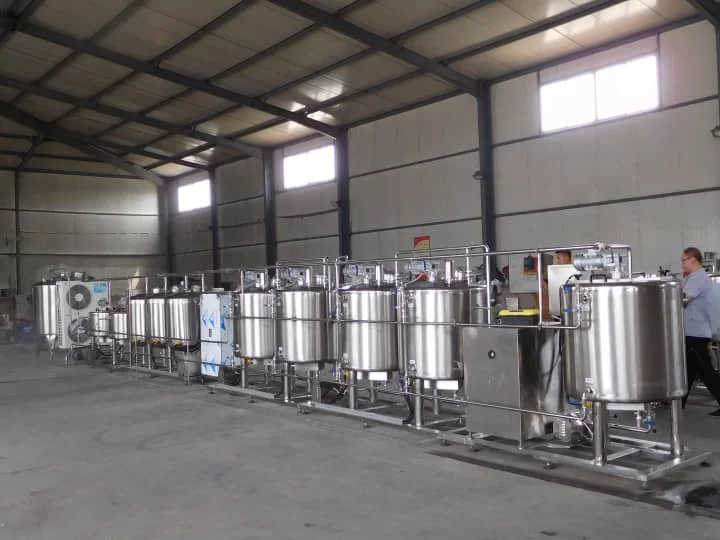
Guide de production de yaourt grec : processus complet, équipements et investissements
Le yaourt grec est devenu l'un des segments à croissance la plus rapide sur le marché mondial des produits laitiers, avec des taux de croissance annuels dépassant 8 % dans de nombreuses régions. Sa texture épaisse et crémeuse et sa teneur élevée en protéines en font un produit premium qui se vend 40-60 % plus cher que le yaourt ordinaire. Ce guide complet couvre tout ce que vous devez savoir sur la production de yaourt grec, du processus de filtration à la sélection des équipements et à la planification des investissements.
Le yaourt grec se distingue du yaourt ordinaire principalement par son processus de filtration, qui élimine le lactosérum et concentre les solides :
Caractéristique
Yaourt classique
Yaourt grec
Différence
Contenu en protéines
3-5 g pour 100 g
8-12 g pour 100 g
2-3 fois plus élevé
Teneur en sucre
10-15 g pour 100 g
4-6 g pour 100 g
50-60 % inférieur
Teneur en matières grasses
2-4 g pour 100 g
5-10 g pour 100 g
2-3 fois plus élevé
Texture
Texture lisse, facile à verser
Épais, crémeux
Filtré
Rendement
100 % du lait
30-40 % du lait
60-70 % du lactosérum éliminé
Prix de vente
1,50-2,50 $/L
3,00-5,00 $/L
Prime de 40-60 %
Explication du processus de filtration
La production de yaourt grec nécessite une étape supplémentaire de filtration après fermentation :
Fermentation standard: Suivre le processus de production du yaourt ordinaire
Filtration: Éliminer le lactosérum par filtration ou centrifugation
Concentration: Atteindre une concentration de 2-3 fois les solides
Emballage: Remplir le yaourt épais dans des contenants
Processus de production de yaourt grec
Flux de production complet
Étape
Processus
Température
Durée
Équipements clés
1. Réception du lait
Tests de qualité et refroidissement
4°C
30 min
Réservoir de réception
2. Standardisation
Ajuster la teneur en matières grasses/protéines
40-50°C
20 min
Tank de standardisation
3. Homogénéisation
Fragmenter les globules de graisse
60-70°C
10 min
Homogénéisateur (200 bar)
4. Pasteurisation
Traitement thermique
90-95°C
10 min
Pasteurisateur
5. Refroidissement
Réduire la température de fermentation
42-45°C
20 min
Refroidisseur à plaques
Inoculation
Ajouter la culture
42-45°C
10 min
Réservoir de fermentation
7. Fermentation
Incubation de la culture
42-45°C
5-7 heures
Réservoir de fermentation
8. Refroidissement
Arrêter la fermentation
4-6°C
30 min
Système de refroidissement
9. Filtration
Retirer le lactosérum
4-6°C
2-4 heures
Système de filtration
10. Emballage
Remplir et sceller
4-6°C
Continu
Machine de remplissage
Principales différences avec la production de yaourt ordinaire
Aspect
Yaourt classique
Yaourt grec
Impact
Besoin en lait
1L de lait = 1L de yaourt
3-4L de lait = 1L de yaourt
Coût plus élevé des matières premières
Temps de Fermentation
6-8 heures
5-7 heures
Légèrement plus court
Étape supplémentaire
Aucun
Filtration (2-4 heures)
Équipements supplémentaires nécessaires
Rendement
95-100%
30-40%
Production par lot inférieure
Durée de conservation
14-21 jours
21-28 jours
Plus long en raison d'une humidité inférieure
Équipements nécessaires pour la production de yaourt grec
Liste des équipements essentiels
Équipement
Fonction
Spécifications
Coût estimé
Réservoir de réception du lait
Stockage du lait cru
500-2000L, SUS 304
$5,000-12,000
Tank de standardisation
Ajuster la composition du lait
500-2000L, avec agitateur
$6,000-15,000
Homogénéisateur
Réduction des globules de graisse
Pression de 200 bar
$7,000-15,000
Pasteurisateur
Traitement thermique
90-95°C, 10 min
$9,000-20,000
Réservoir de fermentation
Incubation de la culture
Contrôlé par température
$10,000-25,000
Système de filtration
Élimination du lactosérum
Centrifugeuse ou membrane
$15,000-50,000
Tank de collecte du lactosérum
Collecter le lactosérum filtré
1000-3000L
$3,000-8,000
Machine de remplissage
Emballage de yaourt épais
500-2000 cups/h
$7,000-20,000
Système de nettoyage CIP
Nettoyage automatisé
Ligne de correspondance
$5,000-12,000
Options de filtration
Le système de filtration est le principal différenciateur pour la production de yaourt grec :
Méthode
Description
Capacité
Coût
Meilleur pour
Séparateur centrifuge
Une rotation à haute vitesse sépare le lactosérum
500-2000L/h
$15,000-30,000
Production moyenne à grande échelle
Filtration par membrane
Membranes d'ultrafiltration
200-1000L/h
$20,000-50,000
Qualité premium, cohérente
Filtration par sac en tissu
Filtration gravitaire traditionnelle
50-200L/h
$2,000-5,000
Artisanal à petite échelle
Centrifugeuse décanteuse
Séparation continue
1000-5000L/h
$30,000-80,000
Production industrielle
Comparaison des méthodes de filtration
Facteur
Centrifugal
Membrane
Sac en tissu
Décanteur
Rendement
35-40%
30-35%
25-30%
35-45%
Temps de traitement
1-2 heures
2-4 heures
8-12 heures
Continu
Rétention de protéines
90-95%
95-98%
85-90%
90-95%
Main-d'œuvre requise
1 personne
1 personne
2-3 personnes
1 personne
Coût de maintenance
Moyenne
Élevé
Faible
Moyenne
Qualité du produit
Excellente
Premium
Bon
Excellente
Coût d'investissement pour la production de yaourt grec
Petite échelle (production quotidienne de 200L)
Équipement
Plage de coûts (USD)
Notes
Tank de réception du lait (600L)
$5,000-8,000
3 fois le volume de lait nécessaire
Tank de standardisation
$6,000-10,000
Pour ajustement de la teneur en matières grasses/protéines
Pasteurisateur (600L)
$9,000-14,000
Température plus élevée pour le style grec
Homogénéisateur
$7,000-10,000
Pression de 200 bar
Tank de fermentation (600L)
$10,000-15,000
Contrôlé par température
Filtre centrifuge
$15,000-25,000
Équipements clés
Tank de collecte du lactosérum
$3,000-5,000
Pour sous-produit
Machine de remplissage
$7,000-12,000
Pour yaourt épais
Système CIP
$5,000-8,000
Nettoyage complet
Équipement total
$67,000-107,000
Mise en place de l’usine
$20,000-40,000
Rénovation, utilités
Fonds de roulement (3 mois)
$25,000-40,000
Dépenses d’exploitation
Investissement total
$112,000-187,000
Petite échelle (production quotidienne de 200L)
Équipement
Plage de coûts (USD)
Notes
Tank de réception du lait (1500L)
$8,000-12,000
3 fois le volume de lait nécessaire
Tank de standardisation
$10,000-15,000
Pour ajustement de la teneur en matières grasses/protéines
Pasteurisateur (1500L)
$14,000-20,000
Température plus élevée pour le style grec
Homogénéisateur
$10,000-15,000
Pression de 200 bar
Tank de fermentation (1500L)
$15,000-25,000
Contrôlé par température
Système de filtration par membrane
$20,000-40,000
Qualité premium
Tank de collecte du lactosérum
$5,000-8,000
Pour sous-produit
Machine de remplissage
$12,000-20,000
Pour yaourt épais
Système CIP
$8,000-12,000
Nettoyage complet
Équipement total
$92,000-167,000
Mise en place de l’usine
$40,000-80,000
Rénovation, utilités
Fonds de roulement (3 mois)
$40,000-60,000
Dépenses d’exploitation
Investissement total
$172,000-307,000
Yaourt grec vs yaourt ordinaire : comparaison de rentabilité
Métrique
Yaourt classique
Yaourt grec
Différence
Lait cru requis
1L par 1L de produit
3-4L par 1L de produit
3-4 fois plus
Coût de production
0,60-0,90 $/L
1,20-1,80 $/L
2 fois plus élevé
Prix de vente
1,50-2,50 $/L
3,00-5,00 $/L
2 fois plus élevé
Marge brute
55-65%
55-65%
Similaire
Revenu quotidien (500L)
$750-1,250
$1,500-2,500
2 fois plus élevé
Profit net mensuel
$8,000-12,000
$15,000-25,000
2 fois plus élevé
Période de Retour sur Investissement
12-18 mois
14-20 mois
Légèrement plus long
Revenus issus du lactosérum
Le processus de filtration produit un lactosérum important pouvant être monétisé :
Produit de lactosérum
Valeur marchande
Processus requis
Potentiel de revenus
Lactosérum liquide
0,10-0,20 $/L
Minime
0,10-0,20 $/L (ligne de 500L)
Concentré de protéines de lactosérum
5-10 $/kg
Séchage, filtration
200-500 $/jour
Poudre de lactosérum
2-4 $/kg
Séchage par pulvérisation
100-300 $/jour
Alimentation animale
0,05-0,10 $/L
Minime
25-50 $/jour
Contrôle de la qualité pour le yaourt grec
Paramètres clés de qualité
Paramètre
Norme
Méthode de test
Fréquence
Contenu en protéines
8-12 g pour 100 g
Méthode Kjeldahl
Chaque lot
Teneur en matières grasses
5-10 g pour 100 g
Méthode Gerber
Chaque lot
pH
4.3-4.6
pH-mètre
Chaque lot
Viscosité
8000-15000 cP
Viskomètre
Chaque lot
Solides totaux
15-20%
Séchage au four
Chaque lot
Contage microbien
<10 000 UFC/g
Numération sur plaque
Quotidien
Problèmes de qualité courants et solutions
Problème
Cause
Solution
Trop liquide
Filtration insuffisante
Prolonger le temps de filtration, vérifier la membrane
Trop acide
Sur-fermentation
Réduire le temps de fermentation, refroidir plus rapidement
Texture granuleuse
Suralimentation
Réduire la pression à 150-200 bar
Séparation du lactosérum
Mauvaise stabilisation
Ajouter des stabilisants (pectine, gélatine)
Arômes désagréables
Contamination
Améliorer l'hygiène, vérifier la culture
Opportunités de marché pour le yaourt grec
Segments de marché en croissance
Segment
Taux de croissance
Prime de prix
Facteurs clés
Yaourt grec nature
6-8 % par an
40-50%
Sensibilisation à la santé
Yaourt grec aromatisé
8-10 % par an
50-60%
Variété de goût
Boissons au yaourt grec
10-12 % par an
60-80%
Praticité
Yaourt grec biologique
12-15 % par an
80-100%
Positionnement premium
Yaourt grec riche en protéines
15-18 % par an
100-120%
Marché du fitness
Profils de consommateurs cibles
Type de consommateur
Besoins clés
Produits préférés
Sensibilité au prix
Consommateurs soucieux de leur santé
Haute teneur en protéines, faible en sucre
Naturel, biologique
Faible
Amateurs de fitness
Contenu en protéines, macros
Riche en protéines, aromatisé
Faible à moyen
Familles
Goût, valeur
En emballages aromatisés, grands formats
Moyenne
Acheteurs premium
Qualité, marque
Biologique, artisanal
Faible
Conclusion
La production de yaourt grec offre un excellent potentiel de profit avec des marges brutes de 55-65 % et une forte demande sur le marché. L'investissement clé est le système de filtration ($15 000-80 000), qui différencie le yaourt grec de la production de yaourt ordinaire. Avec une sélection appropriée des équipements et un contrôle de qualité, une ligne de 500L par jour peut générer un bénéfice net mensuel de 15 000 à 25 000 dollars.
Contact Shuliy Machinery for customized Greek yogurt production line solutions. Our dairy processing experts will help you design the perfect equipment configuration based on your target capacity, product specifications, and budget.
Quelle est la différence entre le yaourt grec et le yaourt ordinaire ?
Le yaourt grec est filtré pour éliminer le lactosérum, ce qui donne une teneur en protéines 2-3 fois plus élevée (8-12 g contre 3-5 g pour 100 g), un taux de sucre réduit de 50-60 %, et une texture épaisse et crémeuse. Il nécessite 3-4 litres de lait pour produire 1 litre de yaourt grec, contre 1:1 pour le yaourt ordinaire.
Combien coûte l'équipement de production de yaourt grec ?
Le coût de l'équipement de production de yaourt grec varie de 67 000 à 167 000 dollars selon la capacité. Le coût supplémentaire principal est le système de filtration (15 000-80 000 dollars), qui n'est pas nécessaire pour la production de yaourt ordinaire. L'investissement total, incluant l'installation et le fonds de roulement, varie de 112 000 à 307 000 dollars.
La production de yaourt grec est-elle rentable ?
Oui, la production de yaourt grec est très rentable avec une marge brute de 55-65 %. Une ligne quotidienne de 500L peut générer un bénéfice net mensuel de 15 000 à 25 000 dollars, avec des périodes de retour sur investissement de 14 à 20 mois. La tarification premium (40-60 % supérieure à celle du yaourt ordinaire) compense les coûts plus élevés des matières premières.
Quels équipements sont nécessaires pour la production de yaourt grec ?
Les équipements essentiels comprennent des tanks de réception du lait, des tanks de standardisation, des homogénéisateurs, des pasteurisateurs, des tanks de fermentation, des systèmes de filtration (centrifugale ou membranaire), des tanks de collecte du lactosérum, des machines de remplissage et des systèmes CIP de nettoyage. Le système de filtration est le principal différenciateur par rapport à la production de yaourt ordinaire.