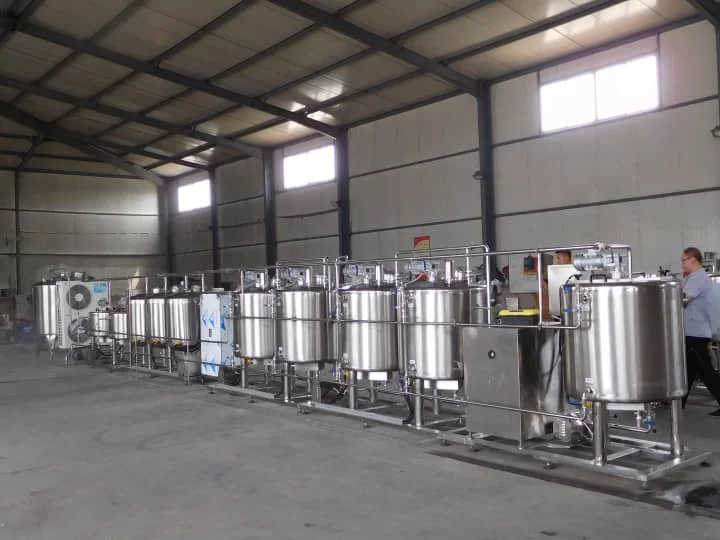
Guide till produktion av Grekisk yoghurt: Komplett process, utrustning och investering
Grekisk yoghurt har blivit en av de snabbast växande segmenten på den globala mejerimarknaden, med årliga tillväxttakter över 8 % i många regioner. Dess tjocka, krämiga konsistens och höga proteininnehåll har gjort den till en premiumprodukt som tar ut 40-60 % högre priser än vanlig yoghurt. Denna omfattande guide täcker allt du behöver veta om produktion av Grekisk yoghurt, från silningsprocessen till utrustningsval och investeringsplanering.
Grekisk yoghurt skiljer sig från vanlig yoghurt främst genom sin silningsprocess, som avlägsnar vassle och koncentrerar fasta ämnen:
Karaktäristiskt
Regulārs jogurts
Grekki-jogurtti
Skillnad
Proteininnehåll
3-5g per 100g
8-12g per 100g
2-3 gånger högre
Sockerinnehåll
10-15g per 100g
4-6g per 100g
50-60 % lägre
Fetthalt
2-4g per 100g
5-10g per 100g
2-3 gånger högre
Tekstur
Slät, hällbar
Tyk, kremet
Silad
Skörd
100 % av mjölken
30-40 % av mjölken
60-70 % vassle borttagen
Försäljningspris
$1,50-2,50/L
$3.00-5.00/L
40-60 % premium
Silningsprocessen förklarad
Tillverkning av Grekisk yoghurt kräver ett ytterligare silningssteg efter jäsning:
Standardjäsning: Följ den vanliga yoghurtproduktionen
Silning: Ta bort vassle genom filtrering eller centrifugering
Konzentration: Uppnå 2-3 gånger fasta ämnen
Pakkaus: Fyll tjock yoghurt i behållare
Process för produktion av Grekisk yoghurt
Fullständig produktionsprocess
Trinn
Protsess
Temperatura
Varaktighet
Kľúčové zariadenia
1. Melkemottak
Kwaliteitscontrole en koeling
4°C
30 min
Prijímacia nádrž
2. Standardisering
Justera fett-/proteininnehåll
40-50°C
20 min
Standardiseringstank
3. Homogenisering
Bryt ner fettglobuler
60-70°C
10 min
Homogenisator (200 bar)
4. Pastörisering
Hittebehandeling
90-95°C
10 min
Pasteuriserer
5. Koeling
Znížiť teplotu na fermentačnú teplotu
42-45°C
20 min
Chladič na platne
6. Inoculatie
Tillsätt kultur
42-45°C
10 min
Fermentačná nádrž
7. Fermentatie
Kultuuri inkubatsioon
42-45°C
5-7 timmar
Fermentačná nádrž
8. Koeling
Stop fermentatie
4-6°C
30 min
Chladiaci systém
9. Silning
Ta bort vassle
4-6°C
2-4 timmar
Silningssystem
10. Emballering
Fyll och försegla
4-6°C
Continu
Plnička
Viktiga skillnader från vanlig yoghurtproduktion
Aspecto
Regulārs jogurts
Grekki-jogurtti
Impact
Mjölkbehov
1L mjölk = 1L yoghurt
3-4L mjölk = 1L yoghurt
Högre råvarukostnad
Fermenteringstid
6-8 hours
5-7 timmar
Lättare kortare
Ytterligare steg
Ingen
Silning (2-4 timmar)
Extra utrustning behövs
Skörd
95-100%
30-40%
Lägre utgång per batch
Houdbaarheid
14-21 dias
21-28 dagar
Längre på grund av lägre fuktighet
Utrustning som krävs för produktion av Grekisk yoghurt
Orodha ya Vifaa Muhimu
Apparatuur
Funktsioon
Maelezo ya kiufundi
Geschatte kosten
Mjölkemottagningsbehållare
Omgårdsförvaring av råmjölk
500-2000L, SUS 304
$5,000-12,000
Standardiseringstank
Justera mjölksammansättningen
500-2000L, med omrörare
$6,000-15,000
Homogenizer
Fetthölje-reducering
200 bar tryck
$7,000-15,000
Pasteuriserer
Hittebehandeling
90-95°C, 10 min
$9,000-20,000
Fermenteringstank
Kultuuri inkubatsioon
Temperaturkontrolliert
$10,000-25,000
Silningssystem
Avlägsnande av vassle
Centrifugal eller membran
$15,000-50,000
Vasslesamlingstank
Samla in silad vassle
1000-3000L
$3,000-8,000
Vulmachine
Paketering av tjock yoghurt
500-2000 koppar/tim
$7,000-20,000
Mfumo wa Kusafisha wa CIP
Automaatne puhastus
Matcha linje
$5,000-12,000
Silningssystemalternativ
Silningssystemet är den avgörande skillnaden för produktion av Grekisk yoghurt:
Método
Beschreibung
Uwezo
Kosten
Më të mirat për
Centrifugalseparator
Höghastighetsrotation separerar vassle
500-2000L/tim
$15,000-30,000
Medel-stor produktion
Membranfiltrering
Ultrafiltreringsmembran
200-1000L/tim
$20,000-50,000
Premiumkvalitet, konsekvent
Silning med tygpåse
Traditionell gravitationssilning
50-200L/tim
$2,000-5,000
Liten skala, hantverksmässig
Decantercentrifuge
Kontinuerlig separation
1000-5000L/tim
$30,000-80,000
Tööstuslik tootmine
Jämförelse av silningsmetoder
Factor
Centrifugal
Membran
Tygpåse
Decanter
Skörd
35-40%
30-35%
25-30%
35-45%
Verwerkingstijd
1-2 timmar
2-4 timmar
8-12 timer
Continu
Proteinhållning
90-95%
95-98%
85-90%
90-95%
Arbeidsvereiste
1 persoon
1 persoon
2-3 personer
1 persoon
Underhållskostnad
Kati
Hoog
Low
Kati
Productkwaliteit
Suurepärane
Premium
Hea
Suurepärane
Investering för produktion av Grekisk yoghurt
Liten skala (200L daglig produktion)
Apparatuur
Kostenbereik (USD)
Anteckningar
Tank för mottagning av mjölk (600L)
$5,000-8,000
3 gånger mjölkmängden behövs
Standardiseringstank
$6,000-10,000
För fett-/proteinjustering
Pastöriserare (600L)
$9,000-14,000
Högre temperatur för grekisk stil
Homogenizer
$7,000-10,000
200 bar tryck
Fermentationstank (600L)
$10,000-15,000
Temperaturkontrolliert
Centrifugalstrainer
$15,000-25,000
Viktiga utrustningsdelar
Vasslesamlingstank
$3,000-5,000
För biprodukter
Vulmachine
$7,000-12,000
För tjock yoghurt
Sistema CIP
$5,000-8,000
Fullständig rengöring
Total utrustning
$67,000-107,000
Faciliteit opzetten
$20,000-40,000
Renoveerimine, kommunaalteenused
Werkkapitaal (3 maanden)
$25,000-40,000
Operationele kosten
Totale investering
$112,000-187,000
Medelstort (500L daglig produktion)
Apparatuur
Kostenbereik (USD)
Anteckningar
Tank för mottagning av mjölk (1500L)
$8,000-12,000
3 gånger mjölkmängden behövs
Standardiseringstank
$10,000-15,000
För fett-/proteinjustering
Pastöriserare (1500L)
$14,000-20,000
Högre temperatur för grekisk stil
Homogenizer
$10,000-15,000
200 bar tryck
Fermentationstank (1500L)
$15,000-25,000
Temperaturkontrolliert
Membranfiltreringssystem
$20,000-40,000
Premiumkvalitet
Vasslesamlingstank
$5,000-8,000
För biprodukter
Vulmachine
$12,000-20,000
För tjock yoghurt
Sistema CIP
$8,000-12,000
Fullständig rengöring
Total utrustning
$92,000-167,000
Faciliteit opzetten
$40,000-80,000
Renoveerimine, kommunaalteenused
Werkkapitaal (3 maanden)
$40,000-60,000
Operationele kosten
Totale investering
$172,000-307,000
Jämförelse mellan Grekisk yoghurt och vanlig yoghurt: Lönsamhetsjämförelse
Metric
Regulārs jogurts
Grekki-jogurtti
Skillnad
Ostrålad mjölk krävs
1L per 1L produkt
3-4L per 1L produkt
3-4 gånger mer
Ražošanas izmaksas
$0.60-0.90/L
$1.20-1.80/L
2 gånger högre
Försäljningspris
$1,50-2,50/L
$3.00-5.00/L
2 gånger högre
Brutomarge
55-65%
55-65%
Liknande
Daglig intäkt (500L)
$750-1,250
$1,500-2,500
2 gånger högre
Månadsnettoresultat
$8,000-12,000
$15,000-25,000
2 gånger högre
Återbetalningstid
12-18 månader
14-20 månader
Lätt längre
Vassleavfallsintäkter
Silningsprocessen producerar betydande mängder vassle som kan kommersialiseras:
Vassleprodukt
Marknadsvärde
Bearbetning krävs
Inntektspotensial
Flytande vassle
$0.10-0.20/L
Minimaal
$50-100/dag (500L linje)
Vassleproteinkoncentrat
$5-10/kg
Torkning, filtrering
$200-500/dag
Vasslepulver
$2-4/kg
Spraytorkning
$100-300/dag
Djurutfodring
$0.05-0.10/L
Minimaal
$25-50/dag
Kvalitetskontroll för Grekisk yoghurt
Viktiga kvalitetsparametrar
Parameter
Standard
Testmetod
Frekvens
Proteininnehåll
8-12g per 100g
Kjeldahl-metoden
Varje batch
Fetthalt
5-10g per 100g
Gerber-metoden
Varje batch
pH
4.3-4.6
pH-meter
Varje batch
Viskositet
8000-15000 cP
Viskometer
Varje batch
Total torrsubstans
15-20%
Oventorkning
Varje batch
Mikrobiell räknare
<10 000 CFU/g
Plankantal
Ikdienā
Vanliga kvalitetsproblem och lösningar
Problem
Orsak
Suluhisho
För tunt
Otillräcklig silning
Förläng silningstiden, kontrollera membranet
För surt
Överfermentering
Minska jäsningstiden, kyla snabbare
Kornig textur
Överhomogenisering
Minska trycket till 150-200 bar
Whey-separasjon
Dålig stabilisering
Tillsätt stabilisatorer (pektin, gelatin)
Bismaker
Contaminare
Förbättra sanitet, kontrollera kultur
Marknadsmöjligheter för Grekisk yoghurt
Växande marknadssegment
Segmenta
Groei Percentage
Prispremium
Nyckelfaktorer
Naturell Grekisk Yoghurt
6-8 % årligen
40-50%
Gezondheidsbewustzijn
Smaksatt Grekisk yoghurt
8-10% gadā
50-60%
Smakvariation
Grekisk yoghurt drycker
10-12% gadā
60-80%
Bekvämlighet
Ekologisk Grekisk Yoghurt
12-15% gadā
80-100%
Premiumpositionering
Högprotein Grekisk Yoghurt
15-18% gadā
100-120%
Fitnessmarknad
Målgrupp
Kundtyp
Viktiga behov
Föredragna produkter
Prissensitivitet
Veselības apzinība
Högt protein, lågt socker
Naturell, ekologisk
Low
Fitnessentusiaster
Proteininnehåll, makronäringsämnen
Högprotein, smaksatt
Laag-middelgroot
Familjer
Smak, värde
Smaksatt, stora förpackningar
Kati
Premium pircēji
Kvalitet, varumärke
Ekologisk, hantverksmässig
Low
Hitimisho
Produktionen av Grekisk yoghurt erbjuder utmärkt vinstpotential med bruttomarginaler på 55-65 % och stark marknadsefterfrågan. Den viktigaste investeringen är silningssystemet ($15 000-80 000), vilket skiljer Grekisk yoghurt från vanlig yoghurtproduktion. Med rätt utrustning och kvalitetskontroll kan en daglig 500L linje generera 15 000-25 000 USD i månadsnetto.
Contact Shuliy Machinery for customized Greek yogurt production line solutions. Our dairy processing experts will help you design the perfect equipment configuration based on your target capacity, product specifications, and budget.
Vad är skillnaden mellan Grekisk yoghurt och vanlig yoghurt?
Grekisk yoghurt silas för att avlägsna vassle, vilket ger 2-3 gånger högre proteininnehåll (8-12g jämfört med 3-5g per 100g), 50-60 % lägre socker, och en tjock, krämig konsistens. Det krävs 3-4 liter mjölk för att producera 1 liter Grekisk yoghurt, jämfört med 1:1 för vanlig yoghurt.
Hur mycket kostar utrustning för produktion av Grekisk yoghurt?
Utrustningskostnader för produktion av Grekisk yoghurt ligger mellan 67 000 och 167 000 USD beroende på kapacitet. Den viktigaste tilläggskostnaden är silningssystemet (15 000-80 000 USD), vilket inte behövs för vanlig yoghurtproduktion. Total investering inklusive anläggning och rörelsekapital ligger mellan 112 000 och 307 000 USD.
Är produktion av Grekisk yoghurt lönsam?
Ja, produktion av Grekisk yoghurt är mycket lönsam med bruttomarginaler på 55-65 %. En daglig linje på 500L kan generera 15000-25000 USD i månadsnetto, med återbetalningstider på 14-20 månader. Den premiumprissättning (40-60 % högre än vanlig yoghurt) kompenserar för de högre råvarukostnaderna.
Vilken utrustning behövs för produktion av Grekisk yoghurt?
Väsentlig utrustning inkluderar mjölkmottagningsbehållare, standardiseringstankar, homogenisatorer, pastöriserare, jäsningstankar, silningssystem (centrifugal eller membran), vassletankar, fyllningsmaskiner och CIP-rengöringssystem. Silningssystemet är den avgörande skillnaden från vanlig yoghurtproduktion.