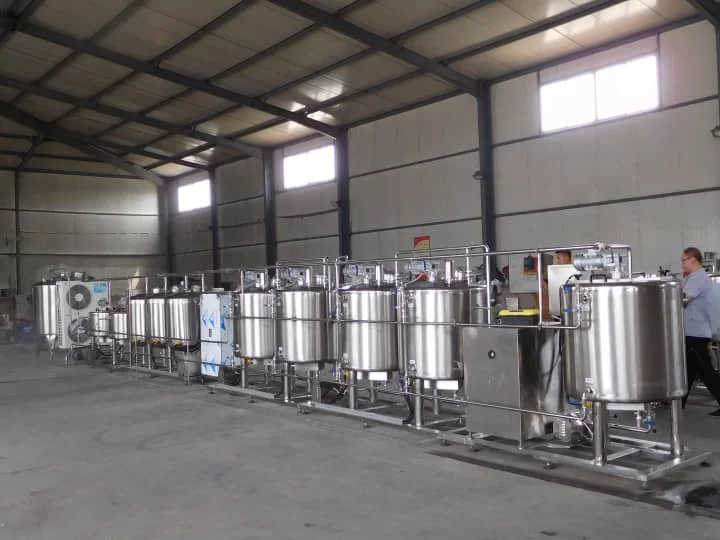
Guia de produção de iogurte grego: Processo completo, equipamentos e investimento
O iogurte grego se tornou um dos segmentos de mais rápido crescimento no mercado global de laticínios, com taxas de crescimento anuais superiores a 8% em muitas regiões. Sua textura espessa e cremosa e alto teor de proteína o tornaram um produto premium que exige preços 40-60% mais altos que o iogurte regular. Este guia abrangente cobre tudo o que você precisa saber sobre a produção de iogurte grego, desde o processo de filtração até a seleção de equipamentos e planejamento de investimentos.
O iogurte grego difere do iogurte regular principalmente pelo seu processo de filtração, que remove o soro e concentra os sólidos:
Característica
Iogurte regular
Iogurte Grego
Diferença
Teor de proteína
3-5g por 100g
8-12g por 100g
2-3x mais alto
Teor de açúcar
10-15g por 100g
4-6g por 100g
50-60% mais baixo
Teor de gordura
2-4g por 100g
5-10g por 100g
2-3x mais alto
Textura
Suave, líquida
Espesso, cremoso
Filtrado
Rendimento
100% do leite
30-40% do leite
60-70% soro removido
Preço de venda
$1,50-2,50/L
$3.00-5.00/L
40-60% premium
O processo de filtração explicado
A produção de iogurte grego requer uma etapa adicional de filtração após a fermentação:
Fermentação padrão: Seguir o processo regular de produção de iogurte
Filtração: Remover soro através de filtração ou centrifugação
Concentração: Alcançar 2-3x de concentração de sólidos
Embalagem: Encher iogurte espesso em recipientes
Processo de produção de iogurte grego
Fluxo de trabalho de produção completo
Estágio
Processo
Temperatura
Duração
Equipamento chave
1. Recepção do Leite
Testes de qualidade e resfriamento
4°C
30 min
Tanque de recepção
2. Padronização
Ajustar teor de gordura/proteína
: 40-50°C
20 min
Tanque de padronização
3. Homogeneização
Quebrar globulos de gordura
60-70°C
10 min
Homogeneizador (200 bar)
4. Pasteurização
Tratamento térmico
90-95°C
10 min
Pasteurizador
5. Resfriamento
Reduzir para temperatura de fermentação
42-45°C
20 min
Resfriador de placas
6. Inoculação
Adicionar cultura
42-45°C
10 min
Tanque de fermentação
7. Fermentação
Incubação de cultura
42-45°C
5-7 horas
Tanque de fermentação
8.. Resfriamento
Parar fermentação
4-6°C
30 min
Sistema de refrigeração
9. Filtração
Remover soro
4-6°C
2-4 horas
Sistema de filtração
10. Embalagem
Encher e selar
4-6°C
Contínuo
Máquina de enchimento
Principais diferenças em relação à produção de iogurte regular
Aspecto
Iogurte regular
Iogurte Grego
Impacto
Requisitos de leite
1L de leite = 1L de iogurte
3-4L de leite = 1L de iogurte
Custo mais alto das matérias-primas
Tempo de Fermentação
: 6-8 horas
5-7 horas
Levemente mais curto
Etapa adicional
Nenhum
Filtração (2-4 horas)
Equipamento extra necessário
Rendimento
95-100%
30-40%
Menor produção por lote
Vida útil
14-21 dias
21-28 dias
Mais longo devido ao menor teor de umidade
Equipamentos necessários para a produção de iogurte grego
Lista de equipamentos principais
Equipamento
Função
Especificações
Custo estimado
Tanque de recepção de leite
Armazenamento de leite cru
500-2000L, SUS 304
$5,000-12,000
Tanque de padronização
Ajustar a composição do leite
500-2000L, com agitador
$6,000-15,000
Homogeneizador
Redução de glóbulos de gordura
Pressão de 200 bar
$7,000-15,000
Pasteurizador
Tratamento térmico
90-95°C, 10 min
$9,000-20,000
Tanque de Fermentação
Incubação de cultura
Controlado por temperatura
$10,000-25,000
Sistema de filtração
Remoção de soro
Centrífuga ou membrana
$15,000-50,000
Tanque de coleta de soro
Coletar soro filtrado
1000-3000L
$3,000-8,000
Máquina de Enchimento
Embalagem de iogurte espesso
500-2000 copos/h
$7,000-20,000
Sistema de limpeza CIP
Limpeza automatizada
Linha de correspondência
$5,000-12,000
Opções de sistema de filtração
O sistema de filtração é o principal diferenciador para a produção de iogurte grego:
Método
Descrição
Capacidade
Custo
Melhor Para
Separador centrífugo
A rotação de alta velocidade separa o soro
500-2000L/h
$15,000-30,000
Produção média-grande
Filtração por membrana
Membranas de ultrafiltração
200-1000L/h
$20,000-50,000
Qualidade premium, consistente
Filtração por saco de pano
Filtração por gravidade tradicional
50-200L/h
$2,000-5,000
Pequena escala, artesanal
Centrífuga decantadora
Separação contínua
1000-5000L/h
$30,000-80,000
Produção industrial
Comparação de métodos de filtração
Fator
Centrífuga
Membrana
Saco de pano
Decantador
Rendimento
35-40%
30-35%
25-30%
35-45%
Tempo de Processamento
1-2 horas
2-4 horas
8-12 horas
Contínuo
Retenção de proteína
90-95%
95-98%
85-90%
90-95%
Mão de Obra Necessária
1 pessoa
1 pessoa
2-3 pessoas
1 pessoa
Custo de manutenção
Medium
Alta
Baixo
Medium
Qualidade do Produto
Excelente
Premium
Bom
Excelente
Custo de investimento para produção de iogurte grego
Pequena escala (200L de produção diária)
Equipamento
Faixa de custos (USD)
Notas
Tanque de recepção de leite (600L)
$5,000-8,000
3x o volume de leite necessário
Tanque de padronização
$6,000-10,000
Para ajuste de gordura/proteína
Pasteurizador (600L)
$9,000-14,000
Temperatura mais alta para estilo grego
Homogeneizador
$7,000-10,000
Pressão de 200 bar
Tanque de fermentação (600L)
$10,000-15,000
Controlado por temperatura
Filtro centrífugo
$15,000-25,000
Equipamento chave
Tanque de coleta de soro
$3,000-5,000
Para subproduto
Máquina de Enchimento
$7,000-12,000
Para iogurte espesso
Sistema CIP.
$5,000-8,000
Limpeza completa
Total de equipamentos
$67,000-107,000
Configuração da instalação
$20,000-40,000
Reforma, utilidades
Capital de Giro (3 meses)
$25,000-40,000
Despesas operacionais
Investimento Total
$112,000-187,000
Escala média (500L de produção diária)
Equipamento
Faixa de custos (USD)
Notas
Tanque de recepção de leite (1500L)
$8,000-12,000
3x o volume de leite necessário
Tanque de padronização
$10,000-15,000
Para ajuste de gordura/proteína
Pasteurizador (1500L)
$14,000-20,000
Temperatura mais alta para estilo grego
Homogeneizador
$10,000-15,000
Pressão de 200 bar
Tanque de fermentação (1500L)
$15,000-25,000
Controlado por temperatura
Sistema de filtração por membrana
$20,000-40,000
Qualidade premium
Tanque de coleta de soro
$5,000-8,000
Para subproduto
Máquina de Enchimento
$12,000-20,000
Para iogurte espesso
Sistema CIP.
$8,000-12,000
Limpeza completa
Total de equipamentos
$92,000-167,000
Configuração da instalação
$40,000-80,000
Reforma, utilidades
Capital de Giro (3 meses)
$40,000-60,000
Despesas operacionais
Investimento Total
$172,000-307,000
Iogurte grego vs Iogurte regular: Comparação de lucratividade
Métrico
Iogurte regular
Iogurte Grego
Diferença
Leite cru necessário
1L por 1L de produto
3-4L por 1L de produto
3-4x mais
Custo de produção
$0.60-0.90/L
$1.20-1.80/L
2x mais alto
Preço de venda
$1,50-2,50/L
$3.00-5.00/L
2x mais alto
Margem bruta
55-65%
55-65%
Semelhante
Receita diária (500L)
$750-1,250
$1,500-2,500
2x mais alto
Lucro líquido mensal
$8,000-12,000
$15,000-25,000
2x mais alto
Período de Retorno
12-18 meses
14-20 meses
Levemente mais longo
Receita de subproduto de soro
O processo de filtração produz um soro significativo que pode ser monetizado:
Produto de soro
Valor de mercado
Processamento necessário
Potencial de Receita
Soro líquido
$0.10-0.20/L
Mínimo
$50-100/dia (linha de 500L)
Concentrado de proteína de soro
$5-10/kg
Secagem, filtração
$200-500/dia
Pó de soro
$2-4/kg
Secagem por spray
$100-300/dia
Ração animal
$0.05-0.10/L
Mínimo
$25-50/dia
Controle de qualidade para iogurte grego
Parâmetros de qualidade chave
Parâmetro
Padrão
Método de teste
Frequência
Teor de proteína
8-12g por 100g
Método Kjeldahl
Cada lote
Teor de gordura
5-10g por 100g
Método Gerber
Cada lote
pH
4.3-4.6
medidor de pH
Cada lote
Viscosidade
8000-15000 cP
Viscometro
Cada lote
Sólidos totais
15-20%
Secagem em forno
Cada lote
Contagem microbiana
<10,000 CFU/g
Contagem em placa
Diário
Problemas de qualidade comuns e soluções
Problema
Causa
Solução
Muito fino
Filtração insuficiente
Aumentar o tempo de filtração, verificar a membrana
Muito azedo
Superfermentação
Reduzir o tempo de fermentação, resfriar mais rápido
Textura granulada
Hiper-homogeneização
Reduzir a pressão para 150-200 bar
Separação de soro
Estabilização deficiente
Adicionar estabilizadores (pectina, gelatina)
Sabores indesejados
Contaminação
Melhorar a sanitização, verificar a cultura
Oportunidades de mercado para iogurte grego
Segmentos de mercado em crescimento
Segmento
Taxa de crescimento
Prêmio de Preço
Principais fatores
Iogurte grego natural
6-8% anualmente
40-50%
Consciência de saúde
Iogurte grego saborizado
8-10% anualmente
50-60%
Variedade de sabor
Bebidas de iogurte grego
10-12% anualmente
60-80%
Conveniência
Iogurte grego orgânico
12-15% anualmente
80-100%
Posicionamento premium
Iogurte grego alto em proteína
15-18% anualmente
100-120%
Mercado fitness
Perfis de consumidores-alvo
Tipo de consumidor
Necessidades chave
Produtos preferidos
Sensibilidade ao preço
Consciente da saúde
Alto teor de proteína, baixo teor de açúcar
Natural, orgânico
Baixo
Entusiastas do fitness
Teor de proteína, macronutrientes
Alto teor de proteína, saborizado
Baixo-Médio
Famílias
Sabor, valor
Saborizado, grandes pacotes
Medium
Compradores premium
Qualidade, marca
Orgânico, artesanal
Baixo
Conclusão
A produção de iogurte grego oferece excelente potencial de lucro com margens brutas de 55-65% e forte demanda de mercado. O principal investimento é o sistema de filtração ($15,000-80,000), que diferencia o iogurte grego da produção de iogurte regular. Com a seleção adequada de equipamentos e controle de qualidade, uma linha diária de iogurte grego de 500L pode gerar $15,000-25,000 de lucro líquido mensal.
Contact Shuliy Machinery for customized Greek yogurt production line solutions. Our dairy processing experts will help you design the perfect equipment configuration based on your target capacity, product specifications, and budget.
Qual é a diferença entre iogurte grego e iogurte regular?
O iogurte grego é filtrado para remover o soro, resultando em 2-3x mais teor de proteína (8-12g vs 3-5g por 100g), 50-60% menos açúcar e uma textura espessa e cremosa. São necessários 3-4 litros de leite para produzir 1 litro de iogurte grego, em comparação com 1:1 para o iogurte regular.
Quanto custa o equipamento para produção de iogurte grego?
Os custos do equipamento para produção de iogurte grego variam de $67,000 a $167,000, dependendo da capacidade. O principal custo adicional é o sistema de filtração ($15,000-80,000), que não é necessário para a produção de iogurte regular. O investimento total, incluindo instalação e capital de giro, varia de $112,000 a $307,000.
A produção de iogurte grego é lucrativa?
Sim, a produção de iogurte grego é altamente lucrativa, com margens brutas de 55-65%. Uma linha diária de 500L pode gerar $15,000-25,000 de lucro líquido mensal, com períodos de retorno de 14-20 meses. O preço premium (40-60% mais alto que o iogurte regular) compensa os custos mais altos das matérias-primas.
Que equipamentos são necessários para a produção de iogurte grego?
Os equipamentos essenciais incluem tanques de recepção de leite, tanques de padronização, homogeneizadores, pasteurizadores, tanques de fermentação, sistemas de filtração (centrífuga ou membrana), tanques de coleta de soro, máquinas de enchimento e sistemas de limpeza CIP. O sistema de filtração é o principal diferenciador da produção de iogurte regular.