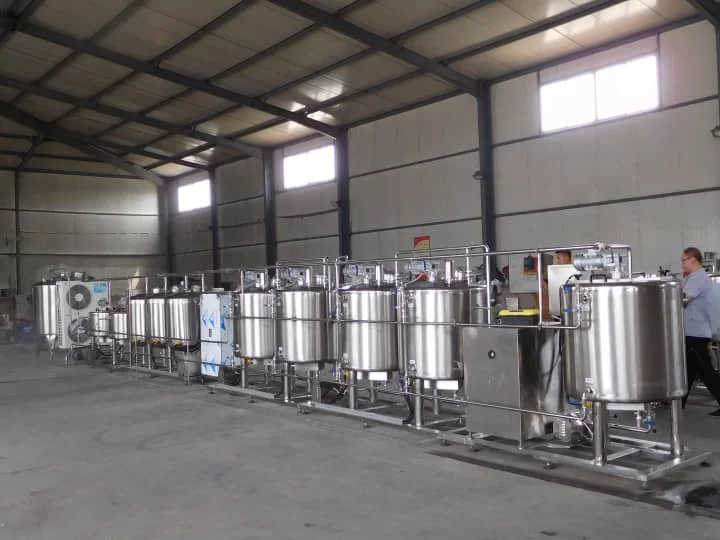
Guía de producción de yogur griego: proceso completo, equipo y inversión
El yogur griego se ha convertido en uno de los segmentos de más rápido crecimiento en el mercado lácteo global, con tasas de crecimiento anuales superiores al 8% en muchas regiones. Su textura espesa y cremosa y su alto contenido proteico lo han convertido en un producto premium que alcanza precios un 40-60% superiores a los del yogur regular. Esta guía completa cubre todo lo que necesita saber sobre la producción de yogur griego, desde el proceso de filtración hasta la selección de equipos y la planificación de inversiones.
El yogur griego se diferencia principalmente del yogur regular por su proceso de filtración, que elimina suero y concentra los sólidos:
Característica
Yogur regular
Yogur griego
Diferencia
Contenido de proteínas
3-5g por 100g
8-12g por 100g
2-3 veces más alto
Contenido de azúcar
10-15g por 100g
4-6g por 100g
Un 50-60% menor
Contenido de grasa
2-4g por 100g
5-10g por 100g
2-3 veces más alto
Textura
Suave, vertible
Espeso y cremoso
Filtrado
Rendimiento
100% de la leche
30-40% de la leche
Se elimina entre un 60 y un 70% del suero
Precio de venta
$1.50-2.50/L
$3.00-5.00/L
: 40-60% de prima
El proceso de filtración explicado
La producción de yogur griego requiere un paso adicional de filtración tras la fermentación:
Fermentación estándar: Seguir proceso regular de yogur
Filtración: Eliminar suero mediante filtración o centrifugación
Densidad: Logre una concentración de sólidos 2-3 veces mayor
Empaquetado: Llenar envases con yogur espeso
Proceso de producción de yogur griego
Flujo completo de producción
Etapa
Proceso
Temperatura
Duración
Equipamiento clave
1. Recepción de leche
Pruebas de calidad y enfriamiento
4°C
30 min
Tanque de recepción
Estandarización
Ajustar contenido de grasa/proteínas
40-50°C
20 min
Tanque de estandarización
3. Homogenización
Descomponer glóbulos de grasa
60-70°C
10 min
Homogenizador (200 bar)
Pasteurización
Tratamiento térmico
90-95°C
10 min
Pasteurizador
5. Enfriamiento
Reducir a la temperatura de fermentación
42-45°C
20 min
Enfriador de placas
6. Inoculación
Agregar cultivo
42-45°C
10 min
Tanque de fermentación
7. Fermentación
Incubación de cultivos
42-45°C
5-7 horas
Tanque de fermentación
8. Enfriamiento
Detener la fermentación
4-6°C
30 min
Sistema de enfriamiento
9. Filtrado
Eliminar suero
4-6°C
2-4 horas
Sistema de filtración
10. Embalaje
Llenar y sellar
4-6°C
Continuo
Máquina de llenado
Diferencias clave respecto a la producción de yogur regular
Aspecto
Yogur regular
Yogur griego
Impacto
Requisito de leche
1L de leche = 1L de yogur
3-4L de leche = 1L de yogur
Costo mayor de materia prima
Tiempo de fermentación
: 6-8 horas
5-7 horas
Un poco más corto
Paso adicional
Ninguno
: Filtrado (2-4 horas)
Equipamiento adicional necesario
Rendimiento
95-100%
30-40%
Menor producción por lote
Vida útil
14-21 días
21-28 días
Mayor duración debido a menor humedad
Equipamiento requerido para producción de yogur griego
Lista de equipo principal
Equipo
Función
Especificaciones
Costo estimado
Tanque de recepción de leche
Almacenamiento de leche cruda
500-2000L, SUS 304
$5,000-12,000
Tanque de estandarización
Ajustar la composición de la leche
500-2000L, con agitador
$6,000-15,000
Homogeneizador
Reducción de globulos de grasa
Presión de 200 bar
$7,000-15,000
Pasteurizador
Tratamiento térmico
90-95°C, 10 min
$9,000-20,000
Tanque de fermentación
Incubación de cultivos
Controlado por temperatura
$10,000-25,000
Sistema de filtración
Eliminación de suero
Centrífugo o membrana
$15,000-50,000
Tanque de recolección de suero
Recolectar suero filtrado
1000-3000L
$3,000-8,000
Máquina de llenado
Empaquetar yogur espeso
500-2000 tazas/h
$7,000-20,000
Sistema de limpieza CIP
Limpieza automatizada
Coincidir línea
$5,000-12,000
Opciones de sistema de filtración
El sistema de filtración es el diferenciador clave para la producción de yogur griego:
Método
Descripción
Capacidad
Costo
Mejor para
Separador centrífugo
La rotación a alta velocidad separa el suero
500-2000L/h
$15,000-30,000
Producción mediana-grande
Filtración por membrana
Membranas de ultrafiltración
200-1000L/h
$20,000-50,000
Calidad premium, consistente
Filtrado con bolsa de tela
Filtrado por gravedad tradicional
50-200L/h
$2,000-5,000
De pequeña escala, artesanal
Centrífuga decantadora
Separación continua
1000-5000L/h
$30,000-80,000
Producción industrial
Comparación de métodos de filtración
Factor
Centrífuga
Membrana
Bolsa de tela
Decantador
Rendimiento
35-40%
30-35%
25-30%
35-45%
Tiempo de procesamiento
1-2 horas
2-4 horas
8-12 horas
Continuo
Retención de proteínas
90-95%
95-98%
85-90%
90-95%
Mano de obra requerida
1 persona
1 persona
2-3 personas
1 persona
Costo de mantenimiento
Medio
Alto
Bajo
Medio
Calidad del producto
Excelente
Premium
Bueno
Excelente
Costo de inversión para la producción de yogur griego
Escala pequeña (200L de producción diaria)
Equipo
Rango de costos (USD)
Notas
Tanque de recepción de leche (600L)
$5,000-8,000
Se necesita 3 veces el volumen de leche
Tanque de estandarización
$6,000-10,000
Para ajuste de grasa/proteínas
Pasteurizador (600L)
$9,000-14,000
Temperatura más alta para estilo griego
Homogeneizador
$7,000-10,000
Presión de 200 bar
Tanque de fermentación (600L)
$10,000-15,000
Controlado por temperatura
Filtro centrífugo
$15,000-25,000
Equipo clave
Tanque de recolección de suero
$3,000-5,000
Para subproducto
Máquina de llenado
$7,000-12,000
Para yogur espeso
Sistema CIP
$5,000-8,000
Limpieza completa
Equipo total
$67,000-107,000
Configuración de la instalación
$20,000-40,000
Renovación, servicios públicos
Capital de trabajo (3 meses)
$25,000-40,000
Gastos operativos
Inversión total
$112,000-187,000
Escala media (500L de producción diaria)
Equipo
Rango de costos (USD)
Notas
Tanque de recepción de leche (1500L)
$8,000-12,000
Se necesita 3 veces el volumen de leche
Tanque de estandarización
$10,000-15,000
Para ajuste de grasa/proteínas
Pasteurizador (1500L)
$14,000-20,000
Temperatura más alta para estilo griego
Homogeneizador
$10,000-15,000
Presión de 200 bar
Tanque de fermentación (1500L)
$15,000-25,000
Controlado por temperatura
Sistema de filtración por membrana
$20,000-40,000
Calidad premium
Tanque de recolección de suero
$5,000-8,000
Para subproducto
Máquina de llenado
$12,000-20,000
Para yogur espeso
Sistema CIP
$8,000-12,000
Limpieza completa
Equipo total
$92,000-167,000
Configuración de la instalación
$40,000-80,000
Renovación, servicios públicos
Capital de trabajo (3 meses)
$40,000-60,000
Gastos operativos
Inversión total
$172,000-307,000
Yogur griego vs yogur regular: comparación de rentabilidad
Métrico
Yogur regular
Yogur griego
Diferencia
Leche cruda requerida
1L por 1L de producto
3-4L por 1L de producto
3-4 veces más
Costo de producción
$0.60-0.90/L
$1.20-1.80/L
2 veces más alto
Precio de venta
$1.50-2.50/L
$3.00-5.00/L
2 veces más alto
Margen bruto
55-65%
55-65%
Similar
Ingresos diarios (500L)
$750-1,250
$1,500-2,500
2 veces más alto
Beneficio neto mensual
$8,000-12,000
$15,000-25,000
2 veces más alto
Período de recuperación
12-18 meses
14-20 meses
Un poco más largo
Ingresos por subproducto de suero
El proceso de filtración produce un suero significativo que puede ser monetizado:
Producto de suero
Valor de mercado
Requiere procesamiento
Potencial de ingresos
Suero líquido
$0.10-0.20/L
Mínimo
$50-100/día (línea de 500L)
Concentrado de proteína de suero
$5-10/kg
Secado, filtración
$200-500/día
Polvo de suero
$2-4/kg
Secado por pulverización
$100-300/día
Alimentación animal
$0.05-0.10/L
Mínimo
$25-50/día
Control de calidad para yogur griego
Parámetros clave de calidad
Parámetro
Estándar
Método de prueba
Frecuencia
Contenido de proteínas
8-12g por 100g
Método Kjeldahl
Cada lote
Contenido de grasa
5-10g por 100g
Método Gerber
Cada lote
pH
4.3-4.6
Medidor de pH
Cada lote
Viscosidad
8000-15000 cP
Viskómetro
Cada lote
Sólidos totales
15-20%
Secado en horno
Cada lote
Conteo microbiano
<10,000 CFU/g
Recuento de placas
Diariamente
Problemas comunes de calidad y soluciones
Problema
Causa
Solución
Demasiado líquido
Filtración insuficiente
Extender el filtrado, verificar membrana
Demasiado ácido
Sobrefermentación
Reducir el tiempo de fermentación, enfriar más rápido
Textura granulada
Sobre-homogenización
Reducir la presión a 150-200 bar
Separación de suero
Estabilización deficiente
Agregar estabilizadores (pectina, gelatina)
Sabores extraños
Contaminación
Mejorar saneamiento, verificar cultivo
Oportunidades de mercado para yogur griego
Segmentos de mercado en crecimiento
Segmento
Tasa de crecimiento
Prima de precio
Factores clave
Yogur griego natural
6-8% anual
40-50%
Conciencia de salud
Yogur griego con sabor
8-10% anualmente
50-60%
Variedad de sabores
Bebidas de yogur griego
10-12% anualmente
60-80%
Comodidad
Yogur griego orgánico
12-15% anualmente
80-100%
Posicionamiento premium
Yogur griego alto en proteínas
15-18% anualmente
100-120%
Mercado de fitness
Perfiles de consumidores objetivo
Tipo de consumidor
Necesidades clave
Productos preferidos
Sensibilidad al precio
Conscientes de la salud
Alto contenido proteico, bajo en azúcar
Natural, orgánico
Bajo
Entusiastas del fitness
Contenido de proteínas, macros
Con alto contenido proteico, con sabor
Bajo-Medio
Familias
Sabor, valor
Con sabores, paquetes grandes
Medio
Compradores premium
Calidad, marca
Orgánico, artesanal
Bajo
Conclusión
La producción de yogur griego ofrece un excelente potencial de beneficios con márgenes brutos del 55-65% y una fuerte demanda en el mercado. La inversión clave es el sistema de filtración ($15,000-80,000), que diferencia la producción de yogur griego de la de yogur regular. Con una selección adecuada de equipos y control de calidad, una línea de yogur griego de 500L diario puede generar entre $15,000 y $25,000 de beneficio neto mensual.
Contact Shuliy Machinery for customized Greek yogurt production line solutions. Our dairy processing experts will help you design the perfect equipment configuration based on your target capacity, product specifications, and budget.
¿Cuál es la diferencia entre el yogur griego y el yogur regular?
El yogur griego se cuela para eliminar suero, resultando en un contenido de proteínas 2-3 veces mayor (8-12g frente a 3-5g por 100g), un 50-60% menos de azúcar y una textura espesa y cremosa. Requiere de 3 a 4 litros de leche para producir 1 litro de yogur griego, en comparación con una proporción 1:1 para el yogur regular.
¿Cuánto cuesta el equipo para producción de yogur griego?
El costo del equipo para producción de yogur griego oscila entre $67,000 y $167,000 dependiendo de la capacidad. El costo adicional principal es el sistema de filtración ($15,000-80,000), que no es necesario para la producción de yogur regular. La inversión total, incluyendo la instalación y el capital de trabajo, oscila entre $112,000 y $307,000.
¿Es rentable la producción de yogur griego?
Sí, la producción de yogur griego es altamente rentable con márgenes brutos del 55-65%. Una línea de 500L diarios puede generar entre $15,000 y $25,000 de beneficio neto mensual, con períodos de recuperación de inversión de 14 a 20 meses. La fijación de precios premium (40-60% más que el yogur regular) compensa los mayores costos de materia prima.
¿Qué equipo se necesita para la producción de yogur griego?
El equipo esencial incluye tanques de recepción de leche, tanques de estandarización, homogenizadores, pasteurizadores, tanques de fermentación, sistemas de filtración (centrífugo o membrana), tanques de recolección de suero, máquinas llenadoras y sistemas CIP de limpieza. El sistema de filtración es el diferenciador clave respecto a la producción de yogur regular.